Debate Leaderboards That Put Top Users in Front of YouTube and Twitch Audiences
Ranked debate rounds could launch unknown arguers into live streaming matchups.

A debate leaderboard with a path to live creators must turn judged performance into a public match. The route is solo AI practice, ranked 1v1 competition, and a creator matchup before a streaming audience. That is the model for putting top users in front of YouTube and Twitch audiences, although a formal rank-to-creator pathway is not yet a standard feature of debate platforms.
Why debate has an audience problem that leaderboards can solve
Live debate already draws large audiences on streaming platforms, including YouTube and Twitch. Political livestreaming has made the back-and-forth of competing claims a familiar thing to watch beyond classrooms and formal tournaments. The audience does not need to be invented. Giving a skilled debater who has no ties to a creator a trusted way onto the screen is harder. An audience can be ready for a challenger long before that challenger has a way to become visible.
Someone can make a clear argument, answer objections, and defend a position under pressure without knowing the people who can get them a guest appearance. Meanwhile, a creator weighing up an opponent they do not know needs reason to think the debate will hold an audience’s attention. Skill alone is difficult to assess before the match. A record of judged competition can show more than someone’s confident pitch or their ties to people the creator knows.
A leaderboard can close this gap by making demonstrated ability visible to the people who arrange public matches. Its role is not simply to identify who has won the most rounds. It must connect that record to an opportunity that would otherwise remain out of reach. Without that connection, a strong debater can become highly ranked and remain just as distant from an audience as before. That changes when a place on the ladder earns a match against a creator or before a live streaming audience.
What makes a leaderboard a pipeline rather than a vanity table
A leaderboard becomes a pipeline when ranking rests on verified performance in judged rounds, people who can offer audience-facing matches can see those rankings, and top placement earns a concrete next step. These conditions serve different purposes. Judging establishes the basis for the ranking, visibility makes that evidence available, and progression gives it a consequence beyond the table. A badge satisfies none of the last requirement by itself. Being seen by an audience also falls short of a pathway if match offers have no link to how well someone debates.
The ELO model, standard in chess and esports, provides the foundation for this structure. Ratings update after every judged round, so a place on the ladder reflects how well someone is doing now. That distinction protects the ladder from becoming a record of longevity. A newcomer who improves quickly can rise on the strength of results instead of waiting to accumulate the history of an established participant. For a pipeline intended to uncover unknown talent, that responsiveness is central to its purpose.
Competitive gaming ladders surface players for tournament brackets, sponsorships, and streamed events. A debate ladder built on the same logic would make argumentation the basis for access to public competition. The comparison concerns the route from performance to opportunity. The comparison holds even if debate and gaming audiences differ and some ranked debaters have no wish for a public career.
The missing link is the final handoff. Ranked competition and live video rounds exist, but a formal connection between ladder-climbers and creator-tier opponents is not yet a standard feature. A platform can therefore offer both ranking and video without offering this pipeline. Strong results must earn a match before an audience, beyond giving the debater a better chance when asking for one.
How AI judging makes leaderboard rankings trustworthy enough to matter
Rankings are worth pursuing only when participants can trust the decisions underneath them. That trust requires judges to score consistently, refer to what was actually said, and apply the same criteria regardless of the debater’s identity. A verdict needs reasons. Otherwise, a leaderboard may look precise even though the people on it cannot understand or challenge the decisions behind it. Getting the judging right matters even more when those decisions help decide who gets a public match.
AI judges can evaluate arguments against predefined criteria, including logic, clarity, evidence, and rebuttal strength. Under those criteria, a speaker must do more than sound impressive to earn a high ranking. AI has no emotional investment in who wins, but that does not make its assessment automatically neutral. A credible system must distinguish a consistent scoring process from an unsupported claim of objectivity.
A panel drawn from independent models, scoring separately with the majority deciding, provides another layer of reliability. No single model then determines the verdict alone. A 2025 study found that multi-agent debate improved correlation with human judgments by 10–16% over single-agent prompting. That finding makes a case for multi-model evaluation, though it does not show that every panel design will do as much better. The panel’s value still depends on the criteria and the quality of its decisions.
The strongest objection is bias inherited from training data. Models may favor certain rhetorical styles even when those styles do not make an argument stronger. The design response is transparency. Scoring criteria should be published before the round, decisions should be citable afterward, and participants should be able to appeal to a human reviewer. These safeguards make a disputed verdict open to examination rather than asking the losing debater to accept an unexplained score. They also establish what creators and audiences can reasonably trust when a ranking is presented as evidence of ability.
How does a debater climb from a first round to a live creator matchup?
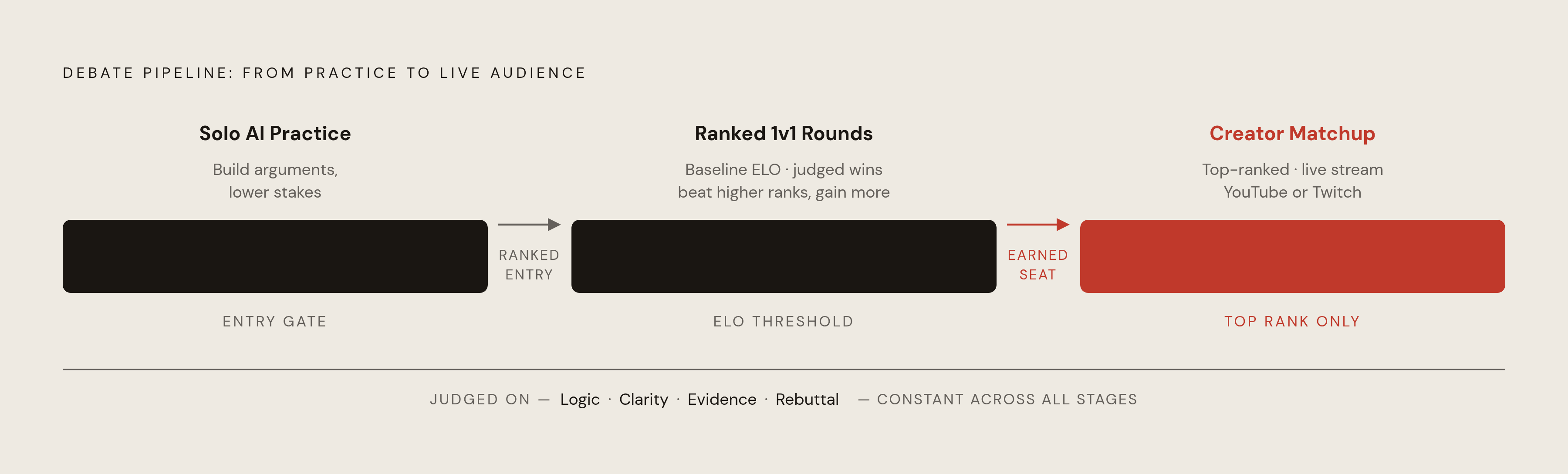
The progression begins with solo AI practice, moves into ranked 1v1 rounds, and culminates in a creator matchup. Each stage serves the next. Solo practice gives a newcomer a lower-stakes setting in which to develop arguments before those arguments face a human opponent in ranked competition. Ranked rounds then turn performance against other debaters into a position on the ladder.
New debaters enter ranked competition at a baseline ELO and move up or down according to their judged results. In the model described here, gains depend on whom they beat and by how much. Beating a higher-ranked opponent yields a larger gain than beating a lower-ranked one. A participant arriving without a reputation can therefore establish one through the strength of opponents defeated, rather than through an audience or network brought from elsewhere.
The practice recommendation is regular short rounds with specific skill goals and a genuine debrief. Three or four focused sessions a week outpace occasional long sessions because the judge’s written decision gives each round a usable consequence. The next attempt can address a weakness in logic, clarity, evidence, or rebuttal instead of simply repeating the previous performance. The score records the result of that effort. The written decision explains where the argument succeeded and where the next session needs attention.
As results get better, the ranking lets others see the progress made in practice. In a functioning pipeline, that visibility reaches people able to offer creator matches, and top placement earns access to the next tier. The skill-development arc’s destination gives the earlier stages a shared purpose, because the eventual opponent is a real creator and the reward is the chance to compete before that creator’s audience.
What a creator matchup actually looks like from both sides of the screen
For a creator, an opponent drawn from a verified leaderboard addresses a production problem. The challenger needs enough ability to make the exchange compelling, but the result should not feel settled before the round begins. An unfamiliar ranked debater offers a useful combination. The person is new to the audience, while the record provides grounds for expecting a substantive contest. Selection can rest on judged performance rather than friendship or a guest’s ability to present a persuasive pitch.
That combination gives the matchup a purpose for viewers as well as participants. The audience sees someone who earned a place in the round through competition face an established creator, with the outcome still in doubt. The leaderboard supplies context before the exchange begins. It explains why an unfamiliar challenger is on screen without requiring that person to arrive with an existing following. Once the round starts, the arguments still have to justify that position.
For the debater, the creator matchup is the highest-stakes version of a format already practiced in lower-stakes settings. The live round is familiar, and the judging criteria remain the same. What changes is the public setting. A larger audience can still create pressure, but the participant does not also have to learn an unrelated competitive format at the point of greatest exposure. The progression separates developing the underlying skill from first displaying it before a creator’s viewers.
This is why the matchup must work as a debate. The creator receives a challenger selected for relevant ability, while the challenger receives a public opportunity grounded in that ability. Both sides can gain in these ways without any assumed partnership with a particular creator. The format’s logic is sufficient, provided the match is real and the route into it is tied to ranking. A leaderboard then contributes something directly useful to the stream, rather than asking the audience to care about a score for its own sake.
Why this model matters for people who never planned to become streamers
Only some participants will reach a creator matchup, but every judged round can contribute to development. A scored, citable decision identifies where an argument held and where it lost ground. That feedback remains useful without an audience. Someone who stops short of the public tier can still practice in the same way to reason better, build a position that holds together, and answer objections more precisely. The destination does not have to become a personal ambition for the route to have value.
Debate practice develops transferable skills, including critical thinking, structured rebuttal, and the ability to hold a position under pressure. Research connects debate practice with improvements in reasoning and communication, while ranked results make progress within the competitive setting visible and comparable. Those are related but distinct benefits. A rating shows how judges scored someone’s debate performance, while much of how that person reasons falls outside its scope. The decisions underneath it provide the detail needed to understand what has improved.
Each round offers a reason to prepare, a reason to review the verdict, and a visible measure against which to judge the next attempt. The score supports the habit rather than replacing it. This differs from casual practice, where an exchange can end without a shared assessment or a clear basis for deciding what to work on next.
Access is the broader consequence of this design. Good debate practice has long depended on a school team or institution with enough resources, leaving many capable people without a place where others could test their arguments over time. A first-timer with an internet connection and an opinion can enter at the same baseline ELO as other newcomers, without an institutional affiliation or an existing audience. From that starting point, consistent practice, tracked and ranked, can produce both stronger arguments and a public record of the ability behind them.


