How Students Without School Debate Teams Build a Competitive Record
Independent students can compete nationally by attaching to homeschools or joining community clubs.

A student with no school debate team is not simply missing a convenience. The barrier that student faces is written into the formal structure of the National Speech & Debate Association, the organization that issues the most widely recognized credential in American scholastic debate. NSDA membership is built around school affiliation: students competing through non-school clubs must register under the school where they are enrolled, and a student found circumventing that rule faces disqualification. For a student at a school with no debate program at all, that rule closes off NSDA membership through the normal channel, and with it, every NSDA-gated qualifier, every bid tied to NSDA sanctioning, and the national recognition that comes from competing inside that system. The effect compounds rather than stays contained to one missed tournament: no membership means no qualifiers, no qualifiers mean no path to NSDA Nationals, and no path to Nationals means no entry into the credentialing system that most colleges and most competitive recruiters recognize first. None of this makes the NSDA's school-based model unreasonable. A membership system organized around institutions is easier to verify, easier to govern, and harder to manipulate than one organized around individuals, and the policy reflects that logic rather than any hostility toward independent students. But the practical result for a student without a sponsoring school is a formal, structural wall, not a gap that more hours of practice alone will close. NSDA has said it is willing to work with clubs that lack school-based membership to help create one, and that virtual schools and homeschools recognized by their state may be eligible to join. That detail matters enough to carry into the next section, because it means the wall has at least one door in it.
The one path that works inside the NSDA system without a traditional team
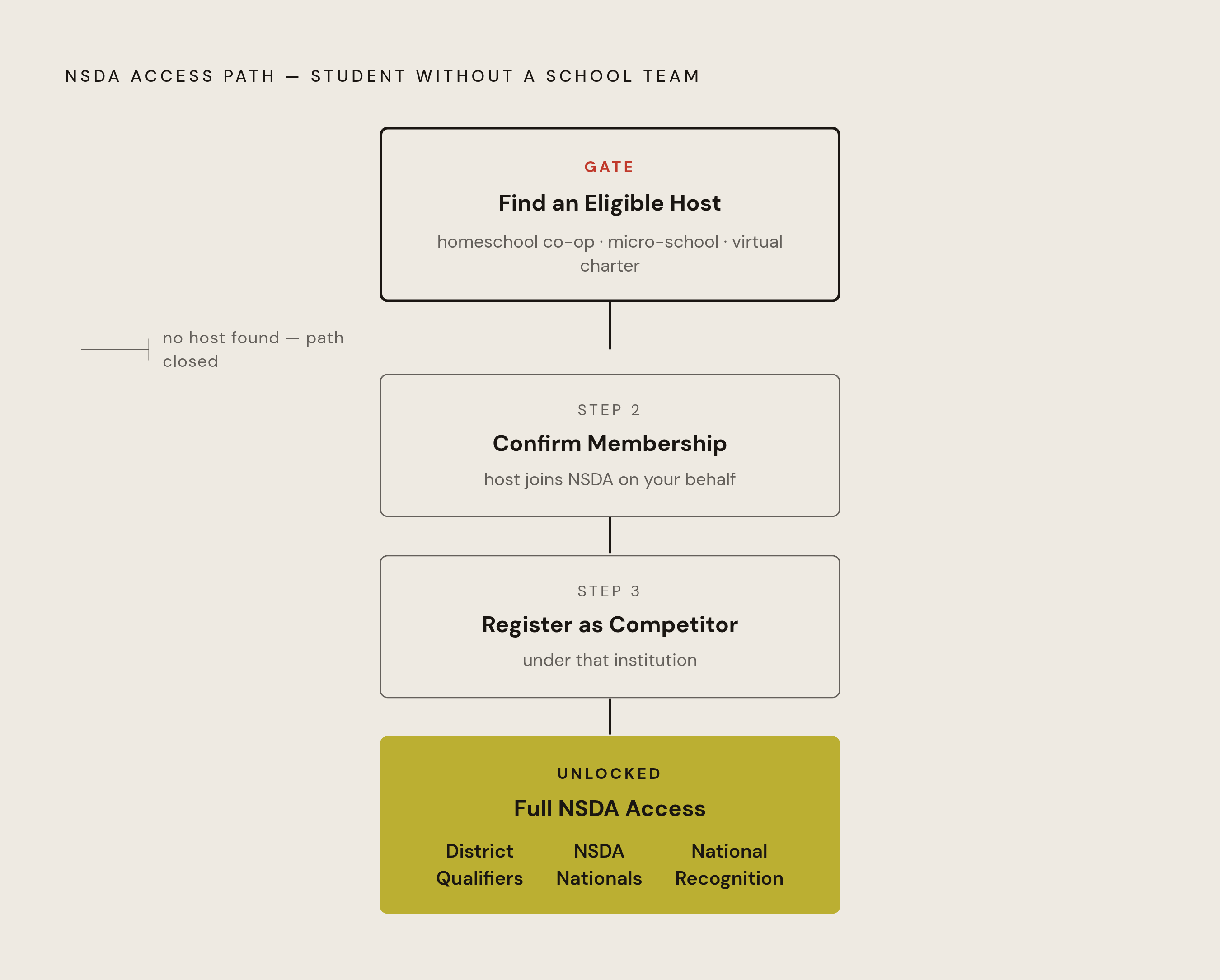
The door is narrow, but it exists. A student without a conventional school team can still gain full access to NSDA competition by attaching to an institution that sponsors a club membership on their behalf, and that institution does not have to be a traditional brick-and-mortar school. NSDA's own policy invites clubs that currently lack school-based membership to contact the organization directly to establish one, and it extends eligibility to homeschool programs and virtual schools recognized by the state in which the student competes. In practice, this means a student identifies a local homeschool co-op, a micro-school, or a virtual charter program that either already holds NSDA membership or is willing to pursue it, registers as a competitor through that institution, and from that point forward has access to the same tournament calendar, qualifiers, and national recognition as any student on a conventional school team. This path's success hinges on finding the right institutional host, and a homeschool co-op or virtual charter willing and able to take on that role may not be nearby for every student. It is the most contingent of the pathways this article maps, and it will not work for every reader. But for the student who can make it work, it is worth pursuing before anything else, because NSDA membership still produces the single most universally recognized record in scholastic debate, including the only route to NSDA Nationals and district-level qualification. For every student who cannot secure that kind of institutional attachment, the remaining sections of this article describe what else actually works.
Independent and community-based clubs that give students a real team structure outside school
Independent debate organizations exist precisely to fill the gap that a missing school team leaves behind, and the better ones do far more than offer a place to practice. They provide coaching, a competitive calendar, and a peer community assembled from outside the school system rather than inside it, functioning the way a school team's infrastructure is supposed to function. The National Debate Club, run by Civic Debate Academy, is built specifically for competitive Public Forum debaters in middle and high school who want more than a typical school team can offer: dedicated coaching, access to the national circuit, and a team culture organized around weekly improvement, whether the student in question is trying to break at a first regional tournament or chasing a TOC qualification. The program's 2026-2027 cycle runs on a defined calendar: Early Bird Registration closes August 1, 2026, general registration closes December 31, 2026, classes begin September 5, 2026, and the first tournament of the season falls in the first week of September. NDC staff handle tournament logistics directly, including travel arrangements, judge registration, hotels, and flights, billed at cost with no markup added. Coaching runs at a 6:1 student-to-coach ratio, and the coaching staff includes university debaters from Harvard, Yale, Northwestern, Duke, Cornell, and Emory, among others. NDC's tournament schedule includes Harvard, Grapevine, Stanford, and dozens of other TOC bid tournaments. A student training through NDC gains direct access to the same national circuit that generates the bid records colleges and competitive rankings track. The trade-off is cost: private coaching organizations charge for this level of access, and a student who cannot afford that fee and also lacks a school team faces two disadvantages stacked on top of each other. A lower-cost nonprofit alternative exists for exactly that situation. The American Debate League, founded in 2014, runs Regional Debate Centers built specifically for students without access to a school debate program, and it sponsors its own tournaments for the students who train through those centers.
Open invitationals and which ones accept independent entries
A competitive record is ultimately built at tournaments, and open invitationals are where that record starts for most students competing outside a traditional school team. Every result that matters in scholastic debate, whether it comes from a school team or an independent entry, gets recorded on Tabroom.com, the platform that handles registration and results for essentially all of competitive scholastic debate in the United States. Rounds won, elimination rounds reached, and bids earned all live there, and that record is the primary currency competitive debate runs on. The national circuit includes dozens of invitational tournaments that do not require NSDA membership to enter, and independent entries alongside entries from private clubs appear regularly in their results. A student building a record this way needs to check each tournament's entry rules on Tabroom.com, since acceptance of entries with no school or club affiliation varies by event. The Tournament of Champions, held at the University of Kentucky in Lexington and scheduled for April 17-19, 2027, requires two bids earned at qualifying tournaments, and in principle those bids can be earned by any debater who reaches the required elimination round, regardless of school affiliation, as long as the student's entry was accepted at that tournament. For a student starting with no tournament history, the practical sequence runs in one direction: enter the open invitationals that accept independent entries, accumulate results on Tabroom, let those results build an opponent-adjusted rating score, and then use that score as documented evidence of competitive standing. The OTR system is transparent rather than opaque: it is drawn from public tournament results rather than calculated behind closed doors, so a student or an outside evaluator can trace exactly which rounds and which results produced a given number. One other entry point deserves separate mention. The NSDA Middle School National Tournament, scheduled for June 16-19, 2026, in Richmond, Virginia, is an open invitational with no qualification process required, open to any school-based NSDA member. For a student who has already secured NSDA membership through a qualifying school under the path described above, this tournament is a direct entry point with no additional qualifier standing in the way.
Scored online practice rounds as the beginning of a verifiable record
A practice round that produces nothing beyond the experience of having argued is not the same thing as a practice round that ends in a scored, written verdict from an identified judging process. The second kind produces an artifact: a record of what was argued, how it was evaluated, and who won, in a form that exists independently of memory and can be shown to someone else later. Platforms built around AI judging and public leaderboards generate artifacts like this at scale, and they do it without requiring a student to have access to a school, a club, or a paid coaching relationship. A ranking system that tracks win rate, argument strength, and performance over time builds a progression record that holds up outside the platform itself: a student can point to a rank, a score history, and a written verdict that cites specifically what was said in the round that produced it. Live rounds against real opponents are marked separately from AI rounds within these systems, so the resulting record distinguishes between practice modes rather than blending them into one undifferentiated number. The case for AI judging rests on its consistency: an AI system applies the same rubric to every round it evaluates and can show the specific reasoning behind a given score, where a human judge may leave feedback that is vague or inconsistent from one round to the next depending on attention and fatigue. AI-judged rounds may not transfer cleanly to tournament rounds judged by coaches who are attuned to strategic framing and format-specific norms that a rubric alone may not capture, and AI judges can inherit biases from their training data that favor particular rhetorical styles over others. AI-judged records are most valuable as evidence of argument mechanics and consistency over time, not as a substitute for tournament results. A student presents a scored online record alongside tournament results. The bias objection is mitigated specifically where judging criteria are published in advance and every verdict cites the actual language of the round, because that transparency lets a student contest a decision and lets an outside reviewer check the reasoning for themselves.
Practicing out loud in ways that transfer to competitive rounds
The skill that competitive debate actually tests is live argumentation under time pressure: presenting a position out loud, listening to a rebuttal, and responding in real time, none of which is practiced by writing cases alone or by discussing debate topics informally with friends or family. Research on debate as an educational method credits it with building not just communication skill but critical thinking, since the format forces a student to present an understanding of a topic, question someone else's reasoning, argue a position they may not hold, and evaluate an opponent's case on its merits. Students who train this way report concrete gains beyond the scoreboard: sharper critical thinking, stronger oral communication, deeper command of subject matter, greater confidence, and a measurably better ability to manage the nerves that come with speaking under pressure. The closest analogy for what this training should look like is chess practice rather than classroom discussion, because chess training depends on a real opponent and a real score, not just engagement with the underlying ideas. For a student with no school team, that training has a natural progression. It starts with solo rounds against an AI opponent, arguing a real topic under structured time limits and receiving a scored verdict with written reasoning attached, which closes the feedback loop by identifying precisely what worked and what failed in the argument itself. From there, the next stage is live, matched one-on-one rounds against a real opponent on an assigned topic, argued out loud and scored at the end, where the presence of an actual person introduces unpredictability that a scripted rebuttal never does and forces a response to reasoning that cannot be anticipated in advance. A further discipline worth building into this progression is practicing sides a student did not choose, since being assigned a position rather than picking it forces the uncomfortable work of steelmanning an argument a student may not personally hold, a mechanism that research on argumentation supports as a genuine driver of better calibration and stronger reasoning. Formats that place a top-ranked student in a live debate against a creator or streamer in front of a public audience add one more layer that none of the earlier stages can replicate on their own: the pressure of performing in front of an audience that is watching in real time, which comes closer to tournament conditions than any private practice round can.
A college-legible record built outside a school team
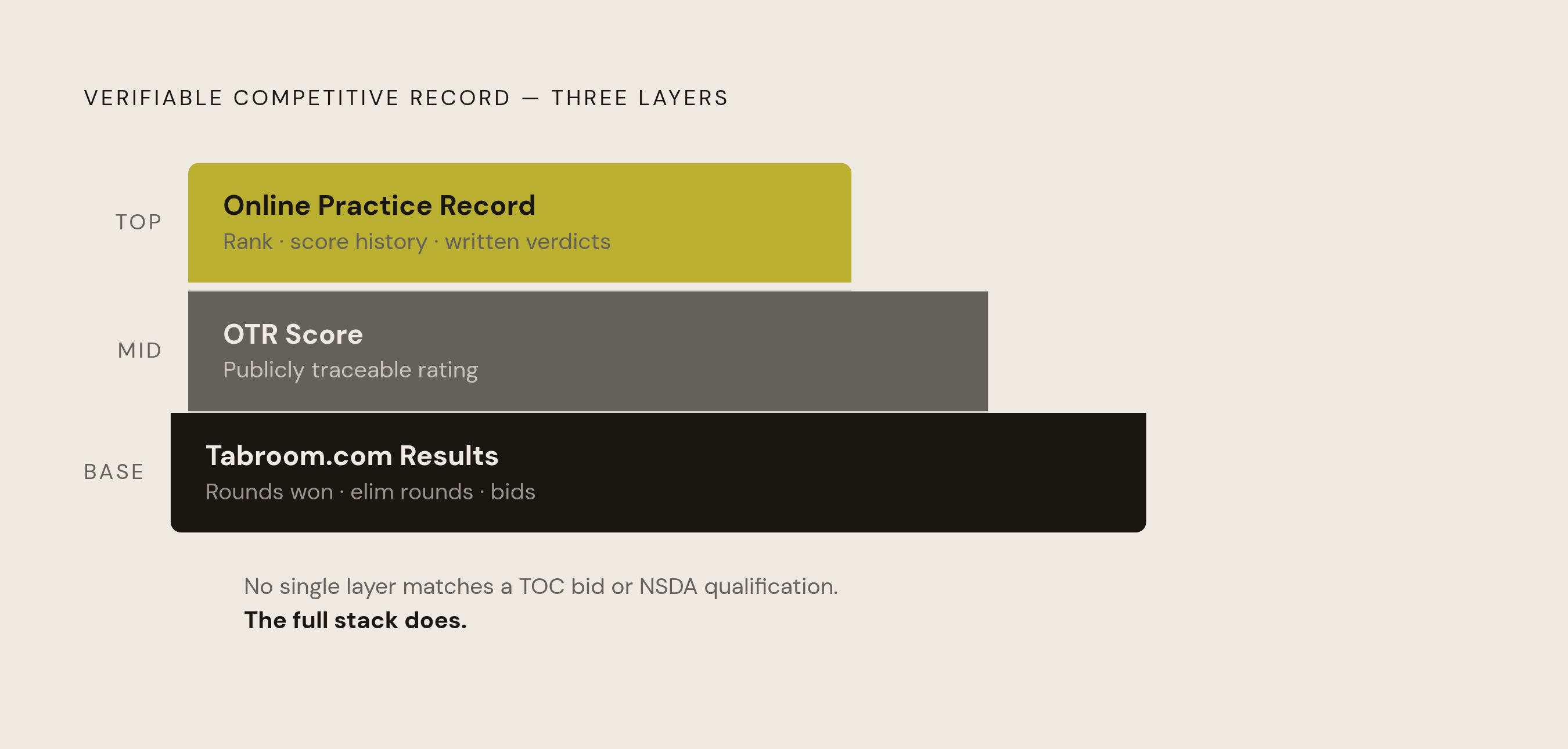
A record assembled this way is a genuine competitive record, built from different sources than a school team would produce, but legible to the same audiences that evaluate a school team's debaters: admissions readers, competitive recruiters, and the debate community itself. At the center of that record sit tournament results logged on Tabroom.com, the primary currency of competitive standing in scholastic debate, where rounds won, elimination rounds reached, and bids earned are recorded for independent entries exactly as they are for entries tied to a school. Built on top of those results sits an OTR score, a transparent, publicly traceable rating derived from actual tournament outcomes rather than from any closed or proprietary formula, giving an outside evaluator a single number backed by a visible history of rounds. Alongside the tournament record sits the kind of evidence scored online practice produces: a rank, a score history, and written verdicts tied to specific rounds, presented not as a replacement for tournament results but as corroborating evidence of argument mechanics and consistency over time. None of these pieces individually matches the weight of an NSDA Nationals qualification or a TOC bid earned the traditional way. Assembled together, tournament results, an OTR score, and a documented practice record describe a student who has competed and improved and can prove both, the actual substance any evaluator outside the debate world is trying to verify.