Platforms That Let Ranked Debaters Face Streamers in Live Judged Rounds
Winning ranked AI-judged debates can earn debaters a shot at live matchups with popular streamers.

A debate leaderboard can provide a path to facing live creators and streamers, with winning earning consideration for a match. The ranked-to-streamer pipeline connects AI-judged rounds to creator broadcasts through four filters, namely leaderboard success, style fit, availability, and invitation.
Why a ranked-to-streamer pipeline is a new thing in debate infrastructure
Competitive debate has had rankings for a long time, and debates have been part of streaming for years. The new structure connects them within one system. Winning judged rounds earns rank, rank puts a challenger into consideration, and selection leads to a live matchup on a creator’s channel with AI judging active. The leaderboard therefore serves a purpose beyond recording competitive results. It becomes a route into a separately programmed broadcast.
That connection belongs to a specific mode of online debate. A live video round against another person differs from a written round decided by AI judges or community vote, a moderated event with audience voting, or an argument map built without an opponent. The pipeline described here is for live, ranked, judged debate, where how well someone debates can lead directly to being picked for a creator matchup.
The four-stage filter that turns a leaderboard rank into a live broadcast seat
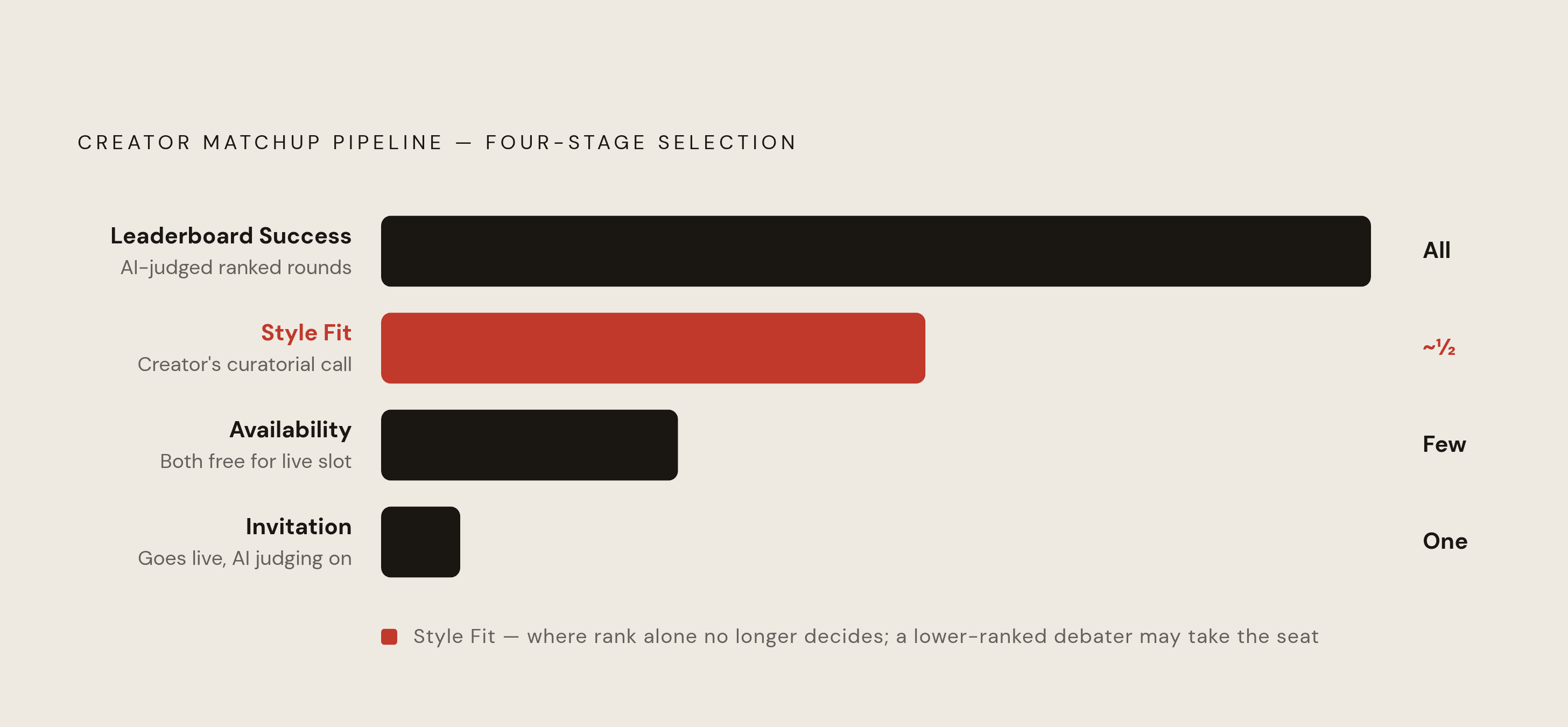
Leaderboard success is the first filter, and it is the competitive part of the process. Debaters earn rank when they win AI-judged rounds against other ranked players. The distinction is important to the offer. A high finish establishes eligibility for selection.
Style fit is the second filter. It asks whether the way a person argues suits the creator’s show, audience, and format, with topic fit also shaping the match. A skilled debater may lose the seat to someone ranked lower whose way of arguing is a better fit for the broadcast. The pipeline is therefore partly meritocratic and partly curatorial, even when the invitation to participate emphasizes winning and climbing.
Availability is the third filter because both sides must be able to make the live slot. A challenger who otherwise fits may be ruled out by the schedule, whatever their rank. The creator must also be available and participating. This is a logistical constraint, and it explains why a strong position on the board cannot guarantee a matchup.
Invitation is the fourth filter and the conversion point. Selected challengers receive the seat and go live on the creator’s channel with judging active. The resulting broadcast follows competitive, editorial, and scheduling decisions. Because the first of those decisions depends on ranked results, the credibility of the judging system is the foundation for everything that follows.
How AI judging makes the ranked rounds credible enough to power the pipeline
AI judging addresses the need for consistent, auditable results. If a leaderboard is to identify potential broadcast challengers, participants need grounds for trusting how its results were produced. The general mechanism combines a decision within seconds of a round ending, a score for each side, and written reasoning that quotes what was said. That explanation is called an RFD, or Reason for Decision. It describes what landed and what was dropped, making the verdict open to inspection rather than leaving participants with only a winner’s name.
debAIt gives scores in five dimensions that add up to a 100-point total. Logic receives 30 points, Evidence 25, Engagement 25, Clarity 15, and Opening/Closing 5. Each round produces a permanent scorecard record. Those weights make the scoring priorities explicit, so a participant can distinguish a weakness in evidence from a weakness in clarity or engagement. The record also gives the result a basis that can be examined after the exchange has ended.
The fairness argument rests on applying the same criteria throughout. Human judges in long competitions may unconsciously shift their standards, while an AI system is intended to apply a consistent rubric to each participant. Consistency is not the same as immunity to exploitation. A debater may learn to optimize for what a model rewards rather than for strong argument, making published scoring dimensions and written explanations essential safeguards.
A written RFD can expose patterns in what the judge rewards, while platforms with human appeal mechanisms have a further check against systematic exploitation. Even with both features, a leaderboard cannot show everything about how ready someone is for a broadcast. A creator assessing style fit can consider whether a challenger argues well for people watching, rather than merely performing well against the model’s preferences. The competitive and editorial filters answer different questions.
What debate platforms let you eventually compete against live creators and streamers?
The decisive distinction is whether a platform completes the circuit. Live rounds, persistent AI-issued rankings, and a creator selection mechanism must all be present for a ranked-to-streamer pathway to exist. A live debate app alone does not establish that pathway, and neither does an ELO leaderboard. The named platform descriptions below document different parts of the infrastructure, but they do not establish a creator route for every service. Their useful points of comparison are format, judging, ranking, and the presence or absence of a documented selection process.
debAIt runs live debates matched by rank and argued in timed turns. Its AI scoring uses the five dimensions described above, and its ranks go from Novice to Luminary. Beyond ranked competition, debAIt+ offers daily AI sparring, and a school license includes curriculum packs, class tournaments, and per-student progress tracking. Those features establish competitive and practice infrastructure, but the supplied platform description does not separately identify its creator selection mechanism.
DebateArena offers real-time debates, ELO rankings, and an AI practice mode. It also provides an interactive tutorial for new users. Its description establishes live competition, a ranking system, and a practice option without specifying the judging method for competitive rounds or a creator pathway. AI practice should not be mistaken for AI adjudication. One describes the opponent used for training, while the other describes how a competitive result is decided.
Debategle is described as a 1v1 debate platform. DebateIt specifies 1v1 live debates, while another platform is described as a live debate app. Further judging, ranking, and creator selection details are not supplied for these services, so those descriptions support only a narrower comparison of format. ArguFight and Debatr have parts of the infrastructure, but not all three elements needed to complete the pipeline.
How the practice ladder beneath the pipeline builds the skills the live rounds reward
There are two rungs below the creator matchup: solo AI practice and ranked live 1v1 competition. Each serves a different developmental purpose. Solo practice provides a setting for repeated argument against a model, while live competition tests that argument against an unpredictable person. The progression is not simply an increase in difficulty. It changes the opponent, the consequences of a result, and eventually the conditions under which the debater must perform.
Solo AI rounds provide practice, but they have a limitation. Repeated exchanges with a model can entrench habits that the model rewards. A human opponent may take advantage of those habits in ways the practice system does not, so doing well against AI does not show that a debater is ready for live competition. The ranked 1v1 rung closes part of that gap by introducing an opponent whose responses cannot be treated as an extension of the training environment.
Ranked rounds also make feedback consequential. Every judged round moves a score, and the written RFD identifies what worked and what went unanswered. That combination creates a feedback loop unavailable in casual discussion, where an exchange need not end with either a verdict or an explanation. A serious debater’s progression therefore involves more than accumulating practice rounds. It means trying practiced arguments against live opponents and using the judges’ decisions to see where those arguments held up.
The streamer rung adds audience observation on a creator’s channel, a topic selected through the matching process, and live judging. Quiet 1v1 performance does not fully train that combination. Skipping the lower rungs can leave a challenger without the live experience needed to adapt, but completing them still does not erase the broadcast gap. This is why the development ladder and the four-stage selection filter work together.
What traditional competitive circuit rankings show about the leaderboard model’s logic
Traditional competitive circuits already use rankings to make achievement legible beyond a single round. Their systems account for opponent strength, tournament depth, and elimination-round performance. The online pipeline borrows that underlying logic rather than inventing talent discovery through results. A win becomes more informative when the ranking system accounts for whom the debater defeated and how far the competitor advanced. The precedent validates the use of ranked records without making online rounds equivalent to circuit competition.
Debate Land, published through NSD, runs national circuit rankings for Public Forum and Lincoln-Douglas debate using an open-source OTR Score. Its points are scaled by how many people attend a tournament, how far debaters go in elimination rounds, and how well they do against top-ranked opponents. As of October 28, 2026, Harvard-Westlake KM (Kaison Maruyama) leads the LD rankings with an OTR of 2.892. Harrison FW (Flynn Williams) is ranked #2 with an OTR of 2.741.
DebateDrills, in partnership with NSD, runs the parallel DD x NSD elo-based rankings, last updated October 14, 2026. Defeating a stronger team yields more points, while losing to a weaker team costs more. Losses in elimination rounds cost fewer points to reward teams that get past preliminary rounds.
Both systems back the idea that doing well against strong opponents is a sign of talent. Their scoring methods are not interchangeable, however, and the online platform descriptions do not establish that every service uses the same weighting. The relevant precedent is the use of contextualized results for decisions beyond the completed round. Traditional circuits use rankings for tournament seeding and college recruitment. The online pipeline adds broadcast talent selection as a further use of competitive standing.
What the live broadcast format demands from debaters that ranked rounds alone do not
A creator-hosted matchup adds pressures that ordinary ranked rounds do not fully measure. A visible audience reacts to the exchange, while the creator’s platform and style shape its framing. Clip-shareability adds another incentive by rewarding memorable moments alongside meticulous argument construction. These conditions change what a successful appearance requires. A debater must still argue effectively, but the argument now has to work as a live broadcast.
That requirement explains the editorial role of style fit. Precision without audience presence may not produce the broadcast the creator or platform seeks. Conversely, a competitive record cannot by itself show how a challenger will respond when audience reactions affect the room. Selection therefore considers a dimension that rank leaves unresolved. It does not need to treat the leaderboard as defective to recognize that it measures something narrower than the full demands of the event.
Debatr explicitly builds for this audience dynamic. Spectators watch live and vote, and debaters can clip their best moment to share. Those features treat the audience as a participant and illustrate the broadcast conditions relevant to creator matchups without establishing that the platform itself completes the ranked-to-streamer circuit.
For a debater seeking an invitation, the practical lesson is to treat every live ranked round as rehearsal for the eventual broadcast format. Developing audience presence also requires debating in front of an audience, because private practice and quiet 1v1 exchanges cannot fully reproduce that pressure. Rank establishes the case for consideration. Turning that consideration into a live creator matchup requires a suitable topic, a workable schedule, and an arguing style that can hold up when the audience becomes part of the event.


