Leaderboard Integrity in AI-Judged Debate Platforms
AI judges need published rubrics, cited verdicts, opponent weighting, and appeals.

Debatable offers a debate leaderboard with a path to live matchups against creators and streamers, where a high rank earns consideration for an invitation. For a leaderboard on an AI-judged debate platform to be trusted, it needs published criteria, citation-backed decisions, opponent-strength weighting, and human appeals.
Why leaderboard rank is worth nothing without structural guarantees
Debatable’s creator-matchup design makes leaderboard integrity a question of both access and status. Chosen challengers get a live slot on a creator’s channel, so a score that cannot be trusted could affect who gets seen on that channel. A newcomer competing for that opportunity needs more than a public number. The newcomer needs reason to believe that the number distinguishes strong debating from favorable scoring conditions.
A leaderboard compresses several judgments into a single position. That position can conceal an undisclosed rubric, an unsupported verdict, or a run against weak opponents. Without structural guarantees, readers cannot tell which of those factors led to the rank.
How AI judging works in practice before asking whether it is fair
AI judging evaluates an exchange across scoring dimensions, including logic, clarity, rebuttal strength, evidence quality, and persuasion. Their relative weight can change across a round, with clarity and relevance counting more early and persuasiveness mattering most in final exchanges. In voice-based debate, speech-to-text sits beneath that evaluation. The scoring layer depends on a transcription of what the speakers actually said.
Platforms organize this process differently. ArguFight assigns three AI judges from a roster of 7 distinct scoring philosophies, including Empiricist, Logician, and Rhetorician. Each judge scores independently from 0–100. Debatezone uses Gemini to assess logic, clarity, rebuttal strength, and persuasion in real time, with Elo updating after each match.
The rubric also determines what counts as a strong performance. Different league formats, including Lincoln-Douglas, Public Forum, and Parliamentary, can weight dimensions differently, with the judging prompt built from the league’s rubric at runtime. The same model can therefore give different verdicts when the rules change. Debatable’s homepage describes its scoring categories as the argument, responses to the other case, and structure and clarity.
The four structural conditions that separate a trustworthy rank from a number
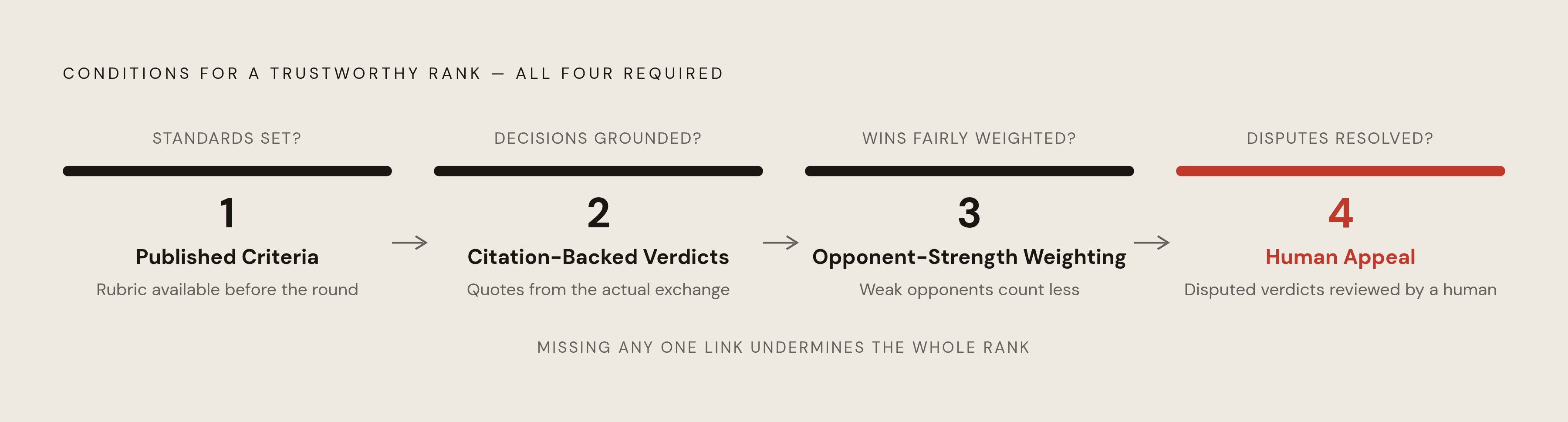
A trustworthy ranking requires four connected conditions. Published criteria define the standard, citations make its application inspectable, opponent-strength weighting makes results comparable, and appeals make errors contestable. Each answers a different question about the score. Meeting three still leaves a gap that the others cannot close.
The first condition is a rubric available before the round begins. Without it, a debater cannot distinguish argument quality from an undisclosed preference. Debatable publishes its scoring rules before either side speaks, giving both participants access to the standard they will face. This is like publishing chess tournament tiebreak rules before round one, when players can still use them. Rules disclosed only after a result cannot guide fair competition.
The second condition is a verdict that cites the actual exchange. General praise for clarity or criticism of weak reasoning does not establish that a judge followed the debate. A citation connects an assessment to a claim or response that the participant can inspect. Debatable’s decisions quote what was actually said and can be appealed to a human reviewer. That gives the explanation both an evidentiary basis and a route to challenge.
The third condition is opponent-strength weighting. Wins against weak opponents must count for less than wins against strong ones, or rank partly rewards choosing easier opponents. Debatezone’s Elo system applies this principle through rating changes after each match. Debatable’s leaderboard page instead states “Only your best round counts” on a flat 100-point scale and does not document opponent-strength weighting. Its published materials therefore do not establish that it meets this condition, and real-time matching alone is not evidence of rating adjustment.
The fourth condition is an appeal mechanism. No scoring system is infallible, and a visible rule provides limited protection if a participant cannot contest its application. Human review gives published criteria practical force by allowing a disputed verdict to be reconsidered. Debatable provides that route rather than returning the dispute to the model that made the decision.
How leaderboards get gamed when these conditions are missing
Any leaderboard creates an incentive to optimize the measured signal independently of the underlying skill. In debate, that gap appears when length, formatting, or confident delivery earns credit without a clear connection to substantive arguments. AI model arenas have used style-control mechanisms to address this skew, and the rankings changed when those controls were used. Citation-backed decisions help expose credit given without a clear connection to substantive arguments by showing whether the judge rewarded an actual contribution to the exchange.
Opponent selection creates a separate vulnerability. Without strength weighting, repeatedly choosing weaker opponents can inflate a record without demonstrating greater skill. Elo-style weighting changes that incentive because beating a low-rated opponent brings a small gain, while losing to one brings a large loss. It stops an exploit that clear explanations alone cannot prevent.
The 2025 paper “The Leaderboard Illusion” documents an undisclosed Chatbot Arena policy that allowed preferred providers, including Meta, Google, OpenAI, and Amazon, to test variants privately and release only the best-performing checkpoint. The debate equivalent would be allowing participants to submit only their strongest completed sessions as evidence of ranked performance. Ordinary practice is not the problem, but presenting selected results as representative performance is. Disclosing total attempts or separating AI practice from live ranked rounds addresses that distinction.
AI-assisted argument delivery is harder to resolve. A judge can assess an argument without knowing whether the speaker drafted it independently. Live spoken exchanges make it harder to get outside help, while cited verdicts can show when arguments fail to answer the other side. Neither safeguard proves who came up with an argument. These are partial protections against a problem that scoring transparency cannot fully solve.
The stronger objection: consistent AI bias versus random human bias
The strongest objection to AI judging is not occasional error but reproducible preference. A model that consistently over-rewards a particular style creates an exploit that participants can reuse across rounds. Known LLM-as-judge problems include self-preference bias, where a model favors outputs like those in its own training distribution, and positional bias, where an output’s place affects how it is judged. Such patterns can look like reliable judgment precisely because they recur.
A panel reduces dependence on any single judge. Debatable uses three AI judges from three different companies and lets either side appeal within a set time window on six stated grounds. The human reviewer can check for shared bias that may be hidden when models agree. Independence reduces one source of risk, but agreement is not proof of correctness.
The defense of consistency still has force. Every participant facing the same standard may be preferable to rotating human judges with undisclosed preferences. But a judge can be biased just as consistently as it can be fair. Transparent rubrics and cited decisions can make a recurring preference discoverable and contestable, even though they do not guarantee its removal. The appeal mechanism matters because the bias problem remains open.
What the real-world stakes of a high rank reveal about platform design
How much a scoring weakness costs depends on what a high rank earns. A leaderboard used for practice has consequences for feedback and motivation. A leaderboard that grants access to public competition also distributes opportunity. If revenue sharing, sponsored belts, or prize tournaments enter the ranking loop, the need for defensible scoring grows further. Stakes and structure must scale together.
ArguFight attaches championship belts to category leaders and allows challengers to contest them directly, subjecting a leading position to repeated competitive tests. A rank that survives motivated challengers carries a different signal from one built against self-selected weak opposition. This adds pressure on the performance behind the position.
Creator access introduces another kind of consequence. On Debatable, selection from the top of the board also depends on topic fit, style fit, creator participation, and availability. Rank is necessary but not sufficient, and the platform earns nothing based on who wins.
How to read a verdict and tell whether a platform's judging is trustworthy
A useful decision identifies claims and rebuttals that were actually made rather than offering comments that could fit any debate on the topic. Read each citation against the argument it is supposed to support. Debatable quotes the round in its verdicts, so readers have passages they can check.
Then examine how the result was assembled. A breakdown by scoring dimension should explain the final number by showing where points were won and lost. The decision should also identify the decisive argument or rebuttal so that the losing side knows what to improve. Generic language, an unexplained score, or a verdict that would read the same if the speakers swapped sides are warning signs. Those signs suggest that the explanation may come from a template with little link to the actual contest.
Finally, compare the decision with the rules available before the round. ArguFight publishes rubric dimensions covering logic, evidence, rhetoric, and rebuttals, while Debatable publishes its scoring rules and routes contested decisions to a human reviewer. If the platform offers no appeal, identifying a mismatch does not provide a correction path. A pre-published rubric and a usable appeal route are the minimum viable integrity test for a verdict, even though a trustworthy leaderboard also needs opponent-strength weighting.
Why practicing in a well-structured system produces faster skill gains than an unscored one
The same design that makes a rank credible makes practice useful. A published rubric identifies the target, a cited verdict locates the mistake, and opponent strength helps distinguish improvement from easier competition. Appeals provide a way to challenge misleading feedback and avoid building practice around it. These mechanisms connect performance to a specific adjustment. Unscored repetition cannot supply the same directed feedback simply by adding more rounds.
In that sense, debate practice resembles chess training more than classroom discussion. Identifying which move cost a participant the game makes a loss useful. A verdict that identifies an unanswered rebuttal or an unsupported claim gives the next round a clear purpose. Debatezone also allows participants to spectate ongoing debates while offering live opponents and immediate Elo updates. Watching judged exchanges can therefore sit beside ranked play as a learning tool.
Access matters because structured feedback has little value to people who cannot obtain it. Debatable offers live rounds with people after sign-in and an Individual plan at $10 a year with 120 AI voice minutes per month. Its free tier gives users 20 total AI voice minutes after sign-in, so they can try judged AI practice before paying. Quality practice should not depend on membership in a well-funded team or institution, and leaderboard integrity is what makes that practice worth using from a first round through sustained competitive play.

